July 14, 2026
Catch up on Part 1 and Part 2 if you're just joining — we left off with a list of ~20 tasks worth investigating for optimization.
The AI Readiness Playbook for Product Teams (Part 3 of 3)
The Final Filter, and Measuring What Matters
Step 7: [Filter 1] Does it move a feeling?
Before AI enters the conversation at all, run your ~20 tasks back through the four outcome factors from Part 1:
- Cross-functional audience — how information reaches non-R&D teams
- Stakeholders feel confident — predictable timing, clear scope, tested use cases
- Don't burden PMs — PMs aren't the bottleneck or the translator
- Minimize hand-holding — the process is repeatable and self-serve
The hypothesis is simple: if changing a task impacts one of these statements, it's worth pursuing — regardless of whether AI is involved. This step alone will tell you which tasks need to be addressed. AI appropriateness is a separate, second question.
Step 8: [Filter 2] Should AI touch this?
For the tasks that survive the first filter, run a second pass — this time asking whether AI is actually the right tool:
- Blast radius — if this goes wrong, how big a deal is it? (Michael Domanic, Head of AI at Section has a good article about these risks)
- Reversibility — is this a two-way door I can back out of?
- Access to tooling — is there a real interface for an agent to act through?
- Access to data – do I have access to the right connectors, cleanly?
- Usefulness of data — is the contextual data in a state an agent can actually use?
- Data privacy compliance — am I allowed to use this data?
- Generative response risk — can this output tolerate some creativity, or does it need to be deterministic?
Worked example
Say weekly project updates in Slack scored red on time and green on value — because tailoring the message for marketing and sales in one channel, CS and solutions in another, and execs in a third, every single week, for every project, eats real PM time. But the payoff is real too: responses are swift, and stakeholders stay engaged.
Run it through filter one: it touches launch checklist completion and ad hoc inquiries metrics directly (cross-functional audience; stakeholders feel confident). Losing it would hit stakeholder satisfaction; fixing it would help PM satisfaction.
Run it through filter two: Slack is an org-approved connector with Claude, so is Jira and Confluence for project context. Blast radius is low — it's internal. Reversibility is high — posts can be corrected or simply drafted and held before sending. This is a legitimate candidate for an AI agent with creative latitude, not just a scripted workflow.
That's the pattern you're looking for: a task that clears both filters cleanly. But even if it doesn’t, the capabilities can change. Take a high-priority task with incompatible data; the next step may be reformatting or consolidating the data in a location for an agent to efficiently scan it to enable future automation.
Step 9: Get 3 to 5, then look for repeating patterns
The goal isn't to automate all 20 tasks right off the bat. It's to find 3-5 you can genuinely work through — get your hands dirty, hit real friction, and learn. Once a few are live, diverge again: look for adjacent tasks that follow a similar pattern. An AI feature request response via Slack using a prioritization framework and knowledge base, for instance, might translate well to ad hoc product inquiries using the same KB context. The take-away is to focus on this method to find good AI-enabled tasks before scaling its use.
Step 10: Measure it, or you're guessing
Go back to the same outcome metrics you associated with the task in Step 6 above. (The full list from Part 1, Step 3: stakeholder SAT, launch checklist completion %, feature request response time, lead time (staging to market), ad hoc inquiries, PM SAT, overtime hours, self-serve dashboard views.) Get a baseline — even if it's manual and quarterly rather than automated and weekly. These changes are about improving from the current state, so you need this baseline figure for accountability.
Putting It All Together
Different teams with different capabilities will be able to jump in and out of this playbook where it makes sense for them–the spectrum of confidence is vast. But you better be able to explain the why. The underlying principle of providing clear direction and support will help you, your teams, and your organization return bandwidth and keep the value flywheel moving forward. AI takes work, but you're not on the journey alone.
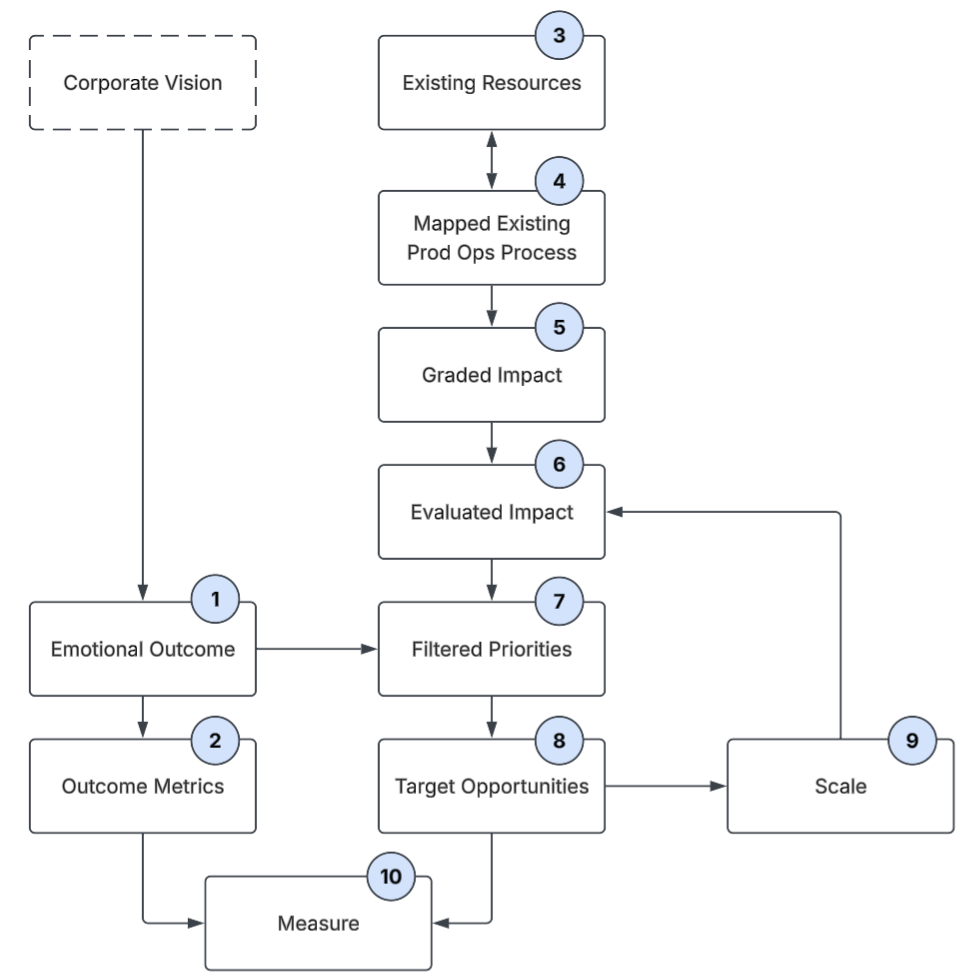
Using the Playbook for Future Needs
What about future-facing needs? These articles reflect on existing processes, people, tools, and artifacts to start from a place of comfort in the known operational landscape. As roles and responsibilities shift, map the opportunistic landscape as if it were the present day and use the same steps to ensure value actions are identified and measured.
A closing personal story
My mission for an organization was to make the PM function's value more visible, and speed to value was my chosen lever. The corporate direction was to ‘embrace more AI’ so I jumped right into tools. I assumed PRD writing was the bottleneck, so I brought in ChatPRD, templated the output, fed it my notes and our knowledge base, and shaved real time off. But once I actually mapped the landscape of tasks—the steps from Part 2—I realized the bigger drain wasn't PRD writing at all. It was the daily grind of reviewing, prioritizing, and responding to incoming feature requests and support tickets: less time per instance, but far higher frequency. The mission didn't change, but the metric did. I added ‘speed to ticket POV’ (i.e., prioritized, declined, or flagged for more detail), and started experimenting with Maven AI and Claude to reduce the ticket processing overhead. The lessons in this article series were how I identified the better value add change: name the feeling, map the process, find the metric, then let the tool follow—not the other way around.
In this scenario, rephrasing it using the goal statement from the first section of Part 1 is:
I will build an AI agent/workflow in Slack to respond to a feature request (reply to the post) using context from the quarterly roadmap, Jira backlog, and knowledge base to reduce the time from request to product POV, which will reinforce inquiry traffic through Slack as the preferred communication method, maintain open communication for inquirers, and build trust between teams with the increased transparency.
To explore more about the frontend of AI strategy, I highly suggest listening to Lenny Rachitsky’s and Claire Vo’s podcasts to see how industry-leading practitioners are doing it. To explore more about AI tooling execution, I love getting Jeff Su’s take on tool comparison and best practices.▫